
 am
am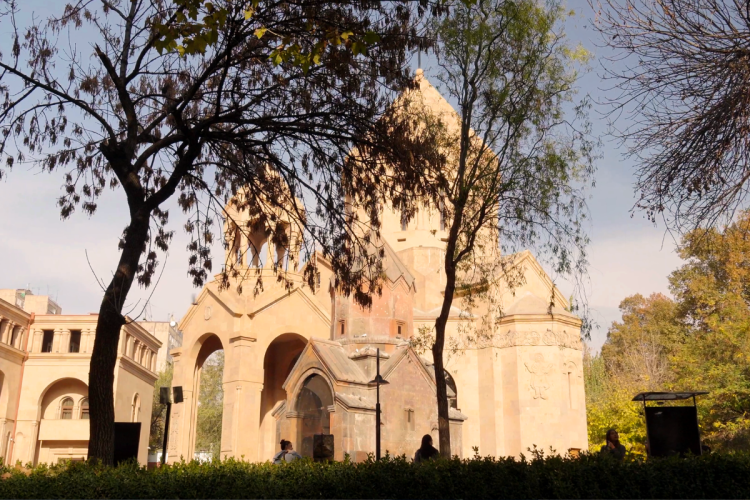
At the intersection of Abovyan Street and Sayat-Nova Avenue, in the middle of Yerevan’s daily hustle and bustle, stands a church that feels both new and rooted. More than a decade has passed since the consecration of the Saint Anna Church and Yerevan Pontifical residence, a project supported by the H. Hovnanian Family Foundation. Over the years, it has become something more durable than a sacred building; today, it stands as a lived space shaped by people, activity, and continuity.
Saint Anna was built next to the 13th-century Katoghike Holy Mother of God Church, which survived the 1679 earthquake and decades of Soviet-era demolition. For many years, Katoghike stood alone, historically significant but physically limited. Its small interior could not accommodate the growing number of worshippers, many of whom followed the Divine Liturgy (Patarag) from the sidewalk outside. The need was clear, but the solution required care.
Hirair and Anna Hovnanian approached the project with that sensitivity in mind. Designed by architect Vahagn Movsisyan, Saint Anna does not dominate or replace the medieval church. Instead, it curves around it, as if to hug it, forming a shared courtyard and a single sacred space where centuries coexist. When the church was consecrated on April 30, 2015, by His Holiness Garegin II, it was named Saint Anna, in honour of the mother of the Virgin Mary, and also as a personal tribute from Hirair Hovnanian to his wife.
What distinguishes Saint Anna and the Pontifical residence today is not only its design but also its use. From early on, it became closely associated with Armenian youth. The church complex houses the headquarters of the Armenian Church Youth Organization (ACYO World), a decision that shaped the space's rhythm. Located in the heart of the city, the church’s courtyard has become a regular gathering place for students and young people. On most afternoons, its benches are full. Conversations overlap with rehearsals, meetings, and informal encounters that feel as much social as spiritual.
This is not incidental. Saint Anna has served as a campus church, where faith is woven into everyday life rather than confined to formal rituals. Youth-led pilgrimages, workshops, and the work of the Veratsnund (Renaissance) youth choir have given the space momentum. In that way, the church reflects the broader approach of the Hovnanian Family Foundation, whose support has consistently focused on people, education, and long-term community development.
The church’s role has also expanded into the city's cultural life. In 2022, the Foundation launched a free summer concert series in Saint Anna’s open-air courtyard, bringing spiritual and classical music to the public. Ensembles such as Tagharan, Hover Choir, and the Little Singers of Armenia have performed there, transforming the space into a shared cultural venue. The series was established in memory of Hirair and Anna Hovnanian, and as then-Foundation Director Naira Melikyan noted at its launch, it was intended to nurture national and spiritual values through accessible cultural expression.
Hirair Hovnanian was known as a builder and for his pragmatism: He spoke openly about the importance of factories, jobs, and infrastructure, often arguing that economic foundations were just as vital to Armenia’s survival as churches. Saint Anna does not contradict that view; rather, it complements it. Hirair understood that while industry sustains a country materially, spaces like Saint Anna sustain its social and moral fabric. Integrated into youth activities and cultural life, the church was never meant to stand apart from the city but to participate in it.
Anna Hovnanian passed away in 2018, and Hirair Hovnanian in 2021, but the impact of their work remains visible on both sides of the Atlantic. Since its founding in 1986, the Foundation they established has distributed tens of millions of dollars, supporting initiatives ranging from healthcare and education to volunteering and cultural preservation. Programs such as the Birthright Armenia, Armenian Volunteer Corps (AVC), and Repat Armenia have brought thousands of young people into direct, sustained engagement with Armenia.
Last October, that same philosophy found expression in a very different kind of space: Tania’s Garden at the Yerevan Botanical Garden. Conceived as a living tribute to the late Tania Chichmanian, the garden was designed and built not as a monument but as a place meant to be used by children, families, volunteers, and visitors. It is a space that grows, changes, and invites return. In that sense, it belongs to the same lineage as Saint Anna: projects that honor people and places not through permanence alone, but through continued life.
Saint Anna Church fits squarely within that approach. Years after its consecration, it stands as a space that continues to absorb the city around it, shaped daily by movement, sound, and participation. Its endurance lies not only in stone, but in the decision to build places that are meant to live on—through use, through community, and through the generations that make them their own.
